
[Previous entry: "Brewster is making a name for himself"] [Main Index] [Next entry: "'Iron Twins' Urango Ready for his IBF Title Shot vs. Rabah!"]
03/30/2006 Archived Entry: "David Estrada on Upcoming Bout with Cintron: ‘I’m Going to Destroy Him!’"
David Estrada on Upcoming Bout with Cintron: ‘I’m Going to Destroy Him!’
By Juan C. Ayllon
Photo by Tom Casino,
Courtesy of http://www.sho.com
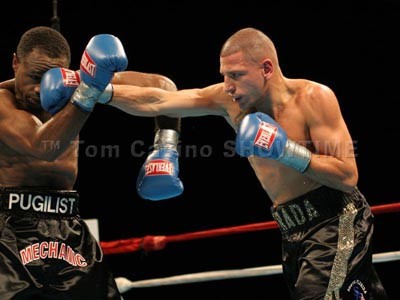
David Estrada (right) hammers Chris Smith
MIAMI – Like most people, David Estrada is a working stiff, slogging it out through traffic to and from work to make a living. He’s in the health club business teaching cardio boxing at various gyms. However, he is also a professional fighter who happens to be ranked eighth in the world by the International Boxing Federation at welterweight.
On April 21st, Estrada will travel to Philips Arena in Atlanta to face dangerous puncher Kermit Cintron, who is 25-1 with 23 knockouts and is rated number five in the IBF. Cintron’s only loss was to WBO Welterweight Champion Antonio Margarito, a heavy-hitter himself, in a fight some criticized as too big a step up in competition on April 23, 2005. Margarito stopped him in the fifth round.
Nevertheless, so formidable is Cintron that boxing writer and former U.S. Air Force Boxing Team member Karl Hegman said via email, “That guy is a KILLER! I watched him train and covered his fight with Teddy Reid ringside here in Houston. The guy is frightening to see fight in person, and he is huge for a welterweight. [In fact,] he looks like a light heavyweight.”
Indeed, Cintron, who at 26 is tall at 5’ 11 with a 72 inch wingspan, sports a two-inch advantage in height and reach over the 5’ 9” Estrada.
Estrada, 27, and 18-2 with nine knockouts, is unimpressed. On the same day Margarito pummeled Cintron, Estrada went the distance with “Sugar” Shane Mosley in losing a unanimous decision. This is the same Mosley who stopped Fernando Vargas in February, won world titles at lightweight and welterweight, and beat Oscar De La Hoya twice.
Moreover, prior to facing Mosley, Estrada was devastating in stopping Chris Smith on January 2005 for the number two welterweight slot in the WBC ratings at welterweight. He intends on doing the same to Kermit Cintron.
At the end of a long day, David Estrada talked about his upcoming match and his career over the telephone with the Cyber Boxing Zone’s Juan C. Ayllon.
JUAN C. AYLLON: How are you doing as far as preparations for your bout against Kermit Cintron? Are you doing anything special to prepare for him that you can tell us?
DAVID ESTRADA: Everything’s going good right now. I’m doing the same thing I always do, nothing special.
I run, hit the gym every day, spar, just like basic—nothing special. [I] sprint sometimes, you know, [do] a little weight training here and there.
[On running], it depends on how I feel that day. Like once a week, I’ll go for a long run, do like six or seven miles and then the rest of the days that I run, it’s like a four-mile run. It just depends on how I feel that day.
JA: Do you do wind sprints?
DE: Yeah, I do sometimes, not all the time.
JA: And what kind of repetitions are you doing when you lift weights?
DE: When I lift weights—I don’t really lift too much weights, but when I do—it’s usually like a lot of reps. Yeah.
JA: What do you do to keep that incredible work rate that you have, like for instance versus Chris Smith and other places, like with Shane Mosley, you’re relentless? How do you get such high energy?
DE: Man, to tell you the truth, I think that’s just my personality when I fight. I mean that’s how I like to fight. I just like to go to war, I don’t really like boxing and stick and move and all that. I wish that the people that I fought would just stand in the middle of the ring with me, and exchange [blows]. That would be like a perfect fight for me, you know? But, then of course, they don’t want to do that, so I’ve got to chase them all over the place until I finally catch them and then they have to fight. So, that’s basically how I fight, man.
JA: What did you learn from your bout against Shane Mosley?
DE: I learned that [I should] never fight 10 round fights again, only 12-rounders because I would have probably knocked him out in the 11th or the 12th round, ‘cause I’m a 12 round fighter. I hate fighting 10 rounds. Like my pace just picks up, like in the 11th and 12th round, I just explode. I don’t know, I guess that’s just the way my timing is.
If you noticed, against Suleymonoglu, I almost knocked him out in the 11th and I didn’t. [Editor’s note: Estrada won by unanimous decision to win the vacant USBA Welterweight Title] I stopped Chris Smith in the 11th, you know, so that’s just the way it works. I need 12 round fights to show my best.
JA: Now against Mosley, he hurt you a couple times with body shots. Is there anything you can tell us you learned from that experience?
DE: Well, he didn’t really hurt me. The only thing he did once, he knocked my air out. And that’s when I grabbed him. ‘Cause if he would have hurt me, I wouldn’t have been able to fight like I did for the rest of the fight. So, it wasn’t that I was injured; it’s just that he knocked my air out, and that only happened once, like in the third round. That was it. Lucky punch—not lucky, I would say perfect timing. He caught me like right when I was inhaling and I was not ready for it. And that’s the first time that ever happened to me in my life, probably first and last.
So, I just learned [if] you make one mistake, [it] could cost you the fight. Basically, I think that’s what I think happened, ‘cause if it wasn’t for that body shot, I think some of the judges would have seen it different, you know. Since he’s a favorite, they’re going to look for any little thing just to give him the fight and that was it, the one body shot.
JA: What about Ishe Smith—do you ever want that fight again to avenge the loss?
DE: Well, to tell you the truth, I don’t even really consider that a loss, ‘cause when I fought him, I was real sick. I don’t know if anybody noticed, but I threw up in the ninth round and then I came out in the tenth round and I dropped him. And then they said that he slipped. But I hit him with a punch [and] he went down.
I mean he came out looking more beat up than I did. You know, I came out clean. He came out with his eyes swollen and he was bleeding out the mouth and the nose. Clearly, they even said it. You know, when they go to the corners during the rest periods, you could hear the guy saying, ‘Clean up his mouth’ and all this, ‘Clean up his nose.’ He was bleeding.
Really, I only consider it one loss to Mosley and that was like barely losing. You know what I mean? But, like Ishe Smith, I don’t really consider that a loss. To me, that was just an experience. It felt like a sparring session to me. It didn’t even feel like a fight.
I didn’t learn nothing from that fight. I just learned if you’re sick, you don’t fight. I felt like I could beat him being sick. I tried it and it didn’t happen. So, I learned my lesson.
I think I have too much pride, sometimes, ‘cause everybody told me, ‘Don’t take the fight.’ [I said,] ‘Like man, [bleep] it, I’ll fight him, anyway. I could beat this dude sick.’ So, I found out, you know.
JA: As far as your bout with Kermit Cintron, I heard from another writer seeing him, he’s like a light heavyweight; at 5’ 11”, he’s a monster. How do you plan on fighting him and dealing with his power?
DE: The way I fight everybody else. You know, I don’t have no respect for Kermit. I didn’t have any respect for ‘Sugar’ Shane, either, [and] he was a three-time world champ, you know? That don’t impress me. I don’t care. Reputations and what people say about people, I don’t pay attention to that stuff, because they never fought me before. So, they don’t know what it’s like.
Like, I’m pretty sure they watched my tapes and think like, ‘Oh, this guy don’t do nothing spectacular, he’s just coming forward.’ But when they get in the ring, it’s a whole different story.
For me, I fight everybody the same way. I don’t care if they’re tall, short, southpaw, fast, whatever. I’m putting that pressure on you until you stand and fight. And that’s basically my game.
JA: Assuming all goes well against Cintron, what next?
DE: I’m trying to look for somebody with a belt. I’ve been calling out, I’ve been trying to get a fight with Margarito. That hasn’t happened. Mayweather is over here at 147 and I would love to fight him! I’d fight Mayweather, Margarito; I would love to have a rematch with Shane, which I think would never happen. I don’t think he’ll do that unless I get a belt. And, still I don’t think he would do it, ‘cause he’s up in the million dollar fights, you know.
I’ll fight anybody that has a belt or anybody that’s going to bring me some good money. I wouldn’t even mind fighting [Ricardo] Mayorga or [Fernando] Vargas. I’d move up to 154 to fight either one of them.
JA: Have you ever sparred with any of these guys?
DE: I’ve been to camp with both of them guys. When I was in camp with Vargas, I was out of shape and I still held my own. I left clean; I didn’t have any bruises or anything on my face.
And then when I sparred with Mayorga, it went real good for me. I’ll just put it like that.
JA: What kind of time frame are you looking to stay in boxing? Are you looking for another five years or so?
DE: Yeah, at least five years! I love to fight. That’s the main reason why I box, ‘cause, there’s other ways to make money. I love to fight. I’ve always loved fighting. That’s why I do this, ‘cause I just love to fight!
To me, it’s not like a sport. It’s more personal. Like, I get in the ring and I never probably seen this dude before in my life, but I just know that I want to destroy him just for the fact that he’s in the ring with me. You know what I mean?
I wouldn’t say that I’m un-sportsmanlike—I wouldn’t even say I’m like that. But, I won’t even shake a guy’s hand until after the fight. I mean, after the fight, we could talk and be whatever—best friends—but before the fight, don’t say ‘hi’ to me, don’t try to talk to me, none of that friendly stuff, you know.
JA: On your ideal wish list of opponents—you’ve mentioned a few, but whom would you really like to fight? And would you like to move up to middleweight?
DE: Not really middleweight right now. I’m too small for that. But, I wouldn’t mind going up. First, there’s a couple guys that are at my weight. I feel like I need to get at least one of the big belts at this weight class before I think about going up. But, I would like to fight at welterweight: I wouldn’t mind fighting Zab [Judah] for the IBF; or Margarito for the belt that he has; and I guess what, the WBC [belt] the dude—[Carlos Baldomir]—from Argentina has. Isn’t [Arturo] Gatti supposed to fight him?
I would love for Gatti to beat him, which I think he’s gonna do, and hopefully I can get a fight with Gatti. I would love to fight Gatti for that belt! That would be one of them fights like him and [Mickey] Ward, you know, or like Barrera-Morales! Those are the kind of fights I would like to be in, and those are the types of fights I love to watch.
I don’t link this dinking, man of the game, and all this stick and move. You know, let’s stand in the middle of the ring and exchange and see who’s who. That’s what I’m talking about. That’s fun to me. It’s not fun to get in there and be trying to chase a dude all over the place.
JA: After hitting your goals of winning a title, do you think you’ll move up to middleweight eventually?
DE: Yeah, I think I’ll probably finish my boxing career at middleweight.
JA: And then what?
DE: And after that, I’m still going to be involved with boxing, since I love it so much. What I would like to do is find fighters like myself that never went to the Olympics, they weren’t really amateur stars ‘cause their style didn’t really fit it, and they never had a big time manager or anything like that. And I would like to make my own little team of fighters like that and then help them out. ‘Cause there’s a lot of fighters out there like that.
I never went to the Olympics. I didn’t have this straight punch style, tap-tap-tap, the white of the glove to the headgear and that’s a point. I was never into that. I fought 60 amateur fights, and a lot of times I lost the fight, but I beat the you-know- [what out of him]—I beat the other dude real bad, blood and everything. But, I’m standing here clean and I lost! You know, that don’t make no sense to me.
So, these guys go to the Olympics, they get Gold Medals, and they’re millionaires before they even have their first pro fight. That’s being basically having a silver spoon in your mouth.
And then they’ve got the people out there like me that have to work and train at the same time and there ain’t nobody helping us out. But, at the same time, we’re taking the harder road and we don’t get respect for it. You know what I mean?
I’ll give you an example. Say you’ve got a regular fighter and then you’ve got one of them dudes that came out of the Olympics and their records are similar. They’re always going to talk big, big about the dude with the medal, and they ain’t gonna say nothing about the other dude. You know what I’m saying? Even though he might be better than the dude that came out of the Olympics.
You know, [I’m] just saying that’s just how it works. You know, they always hate on the underdog, you know?
But, I like being the underdog because I’ve been in there with Olympians and I’ve beat ‘em. So, what does that tell you? Amateurs and professionals are two different things.
JA: You said that you worked and you boxed. What do you do for work?
DE: Well, in the past, I’ve had other jobs. But as far as right now and the past three years, I’ve been working in a cardio boxing gym, teaching boxing classes and stuff like that. It’ll be a setup with a bunch of bags and one person on each bag, and you just put ‘em through a workout for a whole hour.
JA: Does that help keep you in shape as you’re running these classes?
DE: Not really, ‘cause I don’t really do anything when I teach the classes. It’s just that instead of being somewhere away from home for an hour doing that, I could have been at the house resting, like the rest of these fighters that just eat, sleep and [bleep] boxing all day. You know, they get up in the morning, they run, they come home, eat breakfast, they take a shower and they go back to sleep until they’ve got to go back and do their boxing thing in the afternoon.
I don’t get to do that. I’ve got to go and I gotta work, and I work in three different gyms. So, I gotta drive to this gym, teach a class, drive to the other gym, teach a class, and I’ve got to go to this gym and do this training, go to that gym. Dude, it’s like I’m back and forth all day every day, and I should be resting. You know what I’m saying? But, I don’t got it like that. So, I gotta to do what I’ve gotta do.
Hopefully, sometime soon, I will have it like that, and I won’t even have to work. I’ll just be able to train and sleep like the rest of them.
JA: How’s working with Angelo Dundee for you?
DE: Oh man, it’s a real good situation. I mean, I don’t do anything but learn from him. The more you talk to him, the more you learn about boxing and life and all kinds of stuff.
JA: And as far as your trainer, he’s Luis Lagerman?
DE: Yeah, yeah, Luis Lagerman, which was taught how to train fighters by Angelo Dundee.
JA: Do you have anything else you would like to share with the readers?
DE: Nah, just tell them to watch that fight with me and Kermit, ‘cause I’m going to destroy him. And, I will move onto bigger and better things after that.
